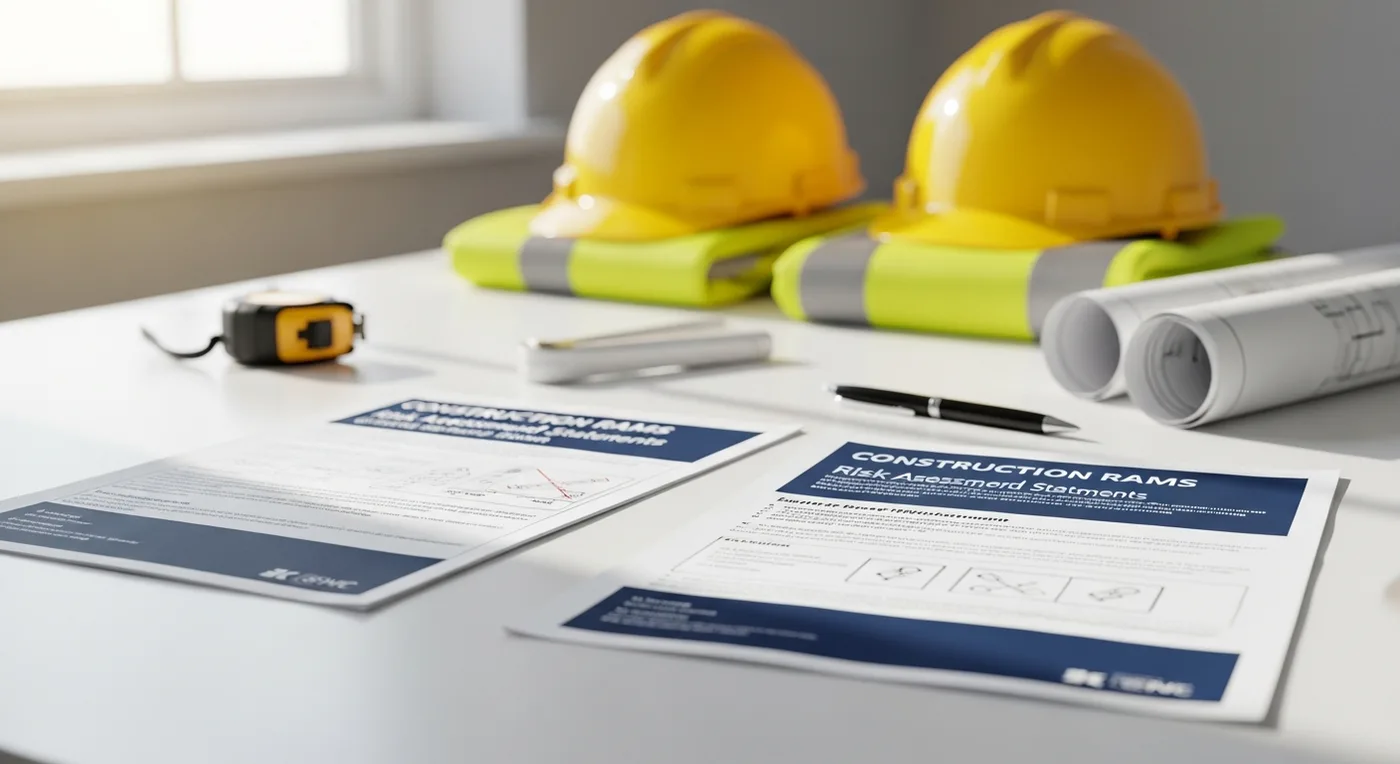
What does RAMS stand for?
RAMS stands for Risk Assessment and Method Statement. It is a combined document that explains two things. First, it identifies the risks associated with a task and how those risks will be controlled. Second, it sets out exactly how the work will be carried out safely, step by step.
In simple terms, the risk assessment looks at what could go wrong, and the method statement explains how you will prevent it from going wrong.
Why are RAMS documents required?
In the UK, businesses have a legal duty under the Health and Safety at Work etc. Act 1974 and the Management of Health and Safety at Work Regulations 1999 to assess risks and protect employees and others from harm.
While the law doesn't specifically say "you must produce a RAMS document," it does require you to carry out risk assessments and implement safe systems of work. RAMS are the practical way most industries meet this requirement.
They are also commonly requested by clients, contractors and site managers before allowing work to begin. If you are entering someone else's premises to carry out work, there is a strong chance you will be asked to provide RAMS in advance. If you are not sure whether your specific job actually needs one, our guide on Do I Need a RAMS Document? UK Guide for 2025 walks through the typical scenarios and when clients legitimately expect one.
What should a RAMS document include?
A proper RAMS document is more than just a template filled in quickly. It should be clear, relevant to the job, and specific enough that someone reading it understands exactly how the work will be carried out safely.
A typical RAMS document will include a detailed risk assessment that identifies hazards such as manual handling, working at height, use of tools or equipment, and environmental risks. It should outline who might be harmed and how, and then clearly define the control measures that will reduce those risks.
The method statement section should then walk through the job step by step. It should explain how the work will be completed, what equipment will be used, how risks will be controlled during each stage, and what procedures are in place if something goes wrong.
Supporting information is often included alongside this, such as employee training records, insurance documents, and any relevant certifications. In many cases, clients expect a full RAMS pack rather than just a standalone document.
When do you need a RAMS document?
You typically need a RAMS document whenever your work involves risk and is being carried out on a client's site or in a controlled environment.
This includes construction work, maintenance, installations, removals, cleaning contracts, electrical work, and many other service-based activities. Even relatively straightforward jobs can require RAMS if they involve manual handling, public interaction, or working within a commercial setting.
If a client asks for RAMS, it is not optional. Without it, you may not be allowed on-site, which can delay jobs, damage relationships, and ultimately cost your business money.
Common mistakes businesses make with RAMS
One of the biggest issues with RAMS is that they are often treated as a box-ticking exercise. Businesses download a generic template, fill it in quickly, and send it off without properly tailoring it to the job.
This creates two problems. First, it can leave gaps in safety planning, which increases risk. Second, it can lead to documents being rejected by clients because they are too vague or clearly copied from elsewhere.
Another common mistake is poor organisation. Businesses often create RAMS as one-off documents and then lose track of them. When a client asks for updated versions, insurances, or supporting documents, everything has to be rebuilt from scratch.
How to create a RAMS document properly
Creating a strong RAMS document starts with understanding the job in detail. You need to think through each stage of the work, identify realistic risks, and apply control measures that actually reflect how your team operates.
Clarity is key. The document should be easy to read, well structured, and professionally presented. It should reflect your business, your processes, and your standards.
It also needs to be stored and managed properly. RAMS are not just one-off documents. They should be reviewed, updated when necessary, and easily accessible when clients request them.
Why most businesses struggle with RAMS
The reality is that creating RAMS manually is time-consuming. You might spend time writing the document, formatting it, adding branding, saving it in the right place, and then attaching it to emails alongside insurances and other documents.
If you have multiple jobs, this process repeats again and again.
Many businesses also rely on different tools for different parts of the process. One tool for writing, another for storage, another for sharing. This leads to inefficiencies and inconsistency across documents.
A better way to manage RAMS
This is exactly why we built Assessment First.
The goal was simple. Remove the friction from creating, managing and sending RAMS documents so businesses can focus on the work itself.
With Assessment First, RAMS documents are created quickly and professionally without the need to manually format or piece together different files. Everything is structured properly from the start, with your branding applied automatically.
More importantly, everything is organised in one place. You can store RAMS per job or per client, alongside insurances, licences and employee records. When a client asks for a RAMS pack, you can send everything through the guided workflow as a complete, professional package.
This is how most contractors actually operate in the real world. Clients do not just want a document. They want confidence that you are organised, compliant and easy to work with.
Why this approach works
What makes this approach different is that it goes beyond just generating a document. It solves the full workflow.
Instead of spending time writing, formatting, saving and chasing files, everything is handled in one system. Documents are consistent, easy to update, and always ready to send.
This not only saves time but also improves how your business is perceived. A clean, well-structured RAMS pack sent quickly gives clients confidence and can support a clearer recipient review.
It also means that even if you only use part of the system, the value is still there. The time saved on just one job can easily outweigh the cost of a monthly subscription.
Final thoughts
A RAMS document is more than just a requirement. It is a reflection of how your business manages safety, communicates processes, and presents itself to clients.
Done properly, it protects your team, meets legal expectations, and supports a clearer recipient review. Done poorly, it creates risk, delays and lost opportunities.
The key is not just creating RAMS, but creating them efficiently, consistently and professionally. That is exactly what Assessment First is designed to do.